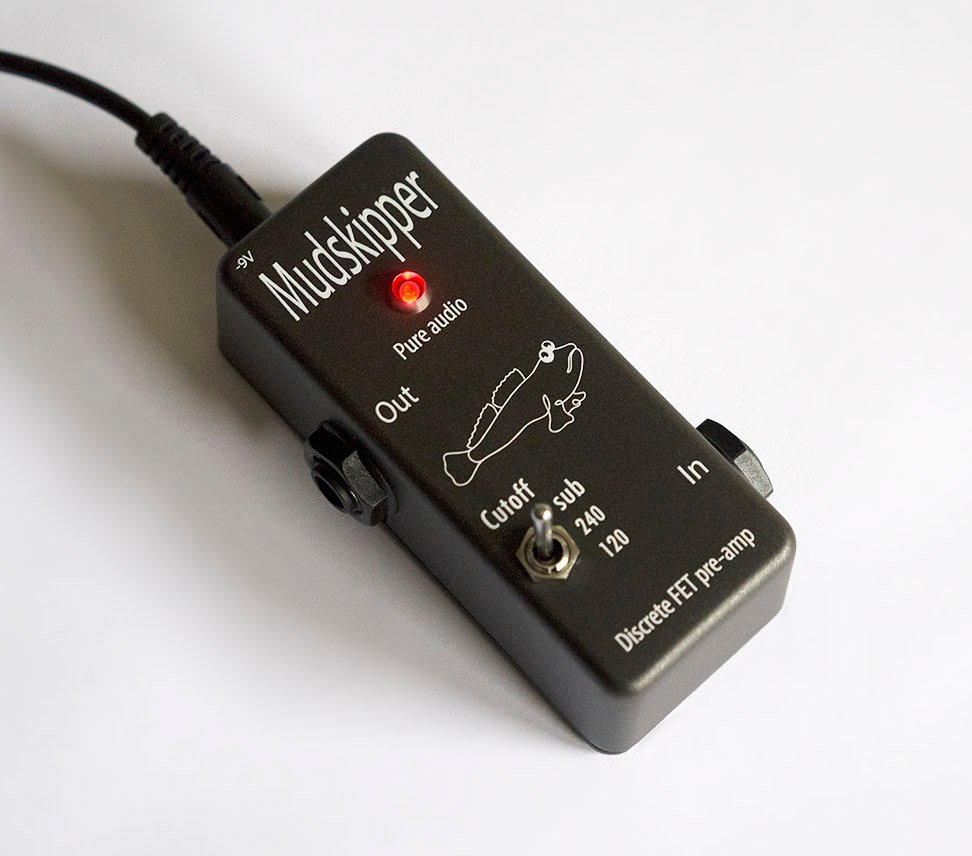
Pure audio discrete JFET pre-amplifier with sub-audio removal
Buy Now (Paypal) – Expected Availability Late December 2026
MUDSKIPPER High impedance discrete FET pre-amp with audio-mud removal
AUD$279 (about USD $195 )
Price is in Australian Dollars, and inclusive of free* world wide shipping.
* Price does not include any duties or tariffs that may be payable upon arrival in your country
The Mudskipper is a pocket-sized, high-impedance, Class-A discrete JFET pre-amplifier. It is specifically engineered to act as an ultra-low-noise front-end buffer that preserves transparent audio at unity gain while eliminating problematic sub-audio frequencies and low-end mud.
Key Features
100% Discrete JFET Architecture: The design features an uncompromising philosophy utilizing zero integrated circuits and zero op-amps to deliver an organic, pure analog audio signal.
Headroom Protection & Sub-Audio Removal: Ultra-low frequencies, rumble, and sub-audio spikes can quietly hijack headroom and cause clicks, pops, or digital clipping. The Mudskipper prevents this by removing these problematic frequencies before they reach your amplifiers or recording gear.
High-Pass Filter: It features an active high-pass filter built entirely from discrete JFETs with three switchable cutoff frequencies: Sub removal, 120Hz, or 240Hz.
The Perfect Front-End for Contact Mics: While it functions seamlessly with any instrument, it was originally created for high-impedance electro-acoustic sensors like the piezo mics used in my daxophones or acoustic guitars with body-mounted soundboard transducers (SBT). It fixes the typical “thin and tinny” sound of these pickups by correcting the impedance mismatch, while simultaneously giving you the tools to tame unwanted low-freqeuncy noises and resonances.
Dimensions & I/O: Housed in a compact 90x35x30mm enclosure, with standard 1/4″ mono input/output jacks.
Power Requirements: Operates via a standard 9V DC guitar pedal power supply (center negative), making it pedalboard-friendly.
Here’s a demo using a daxophone : First the raw signal recorded with a high-impedance device to preserve low frequencies. And then with the Mudskipper in line set to each of its three filter settings: sub, 120Hz, 240Hz.